 +442070316050






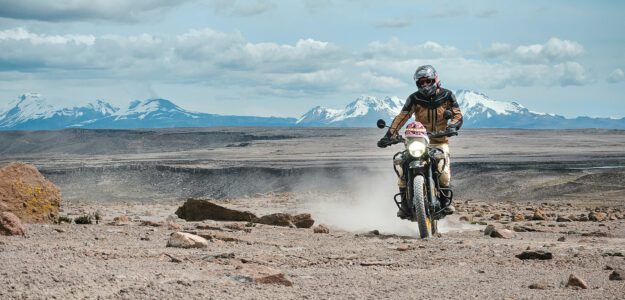


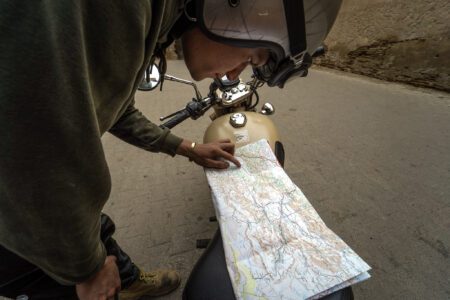


The vast Indonesian archipelago fuels the imagination of travellers and the desire to explore new places. From Bali to Java, the transition from one world to another reveals two distinct universes shaped by the same volcanic fury. To turn our dreams into memories, there’s nothing better than taking the back roads on a motorbike!
Before embarking on this Indonesia motorcycle tour for the first time to launch Vintage Rides, I only knew Indonesia through a few evocative names like Borneo, Jakarta, and, above all, Bali. In reality, Indonesia comprises no fewer than 13,000 islands scattered between the Indian Ocean and the China Sea. I suspected it had a tropical climate, numerous volcanoes and beaches fringed with coconut trees. And of course, I had heard of Bali as a Hindu enclave adored for its gentle way of life and extraordinary surfing spots.
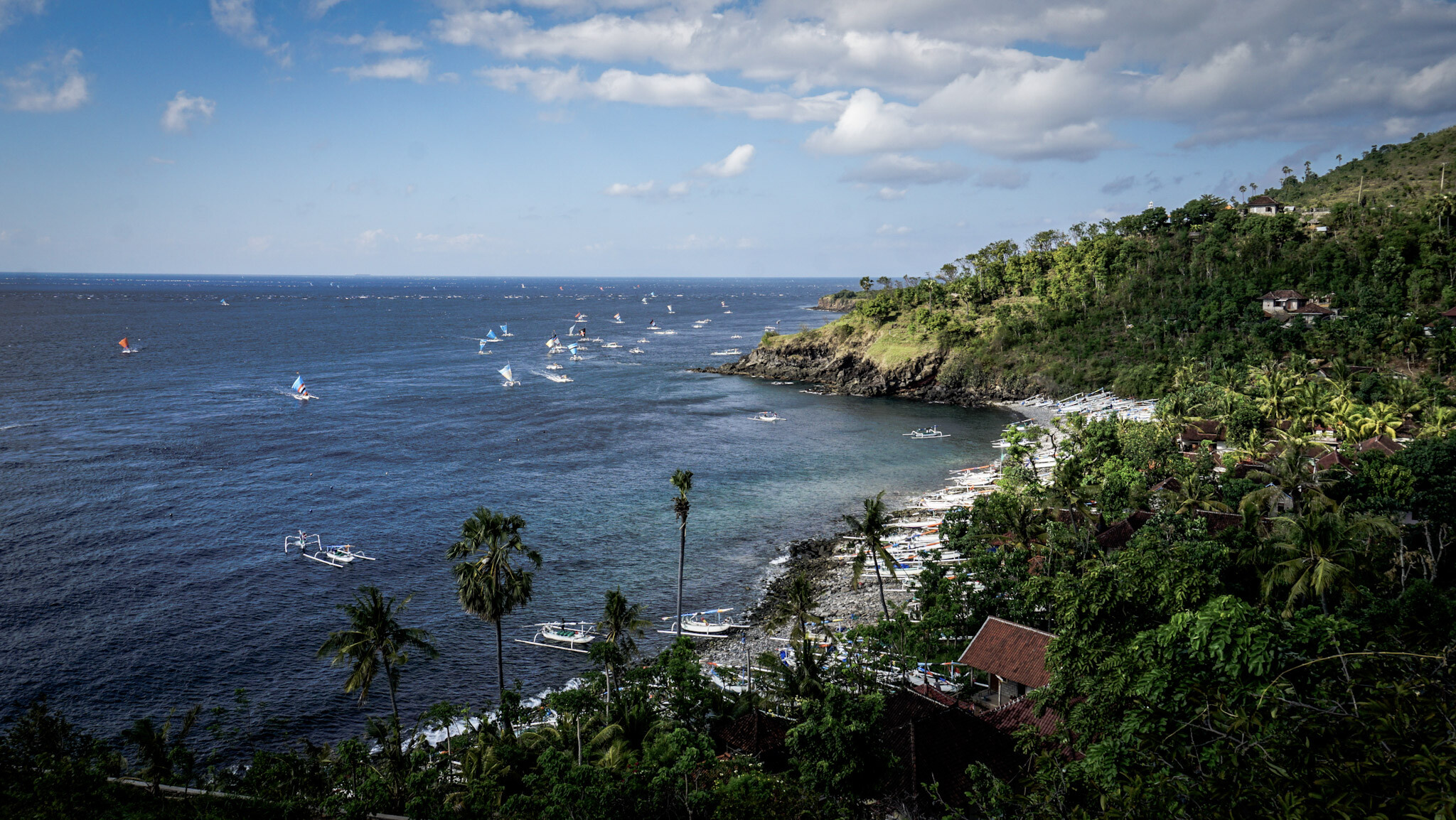
Between two islands
No sooner had François and I landed on the island of the gods than we learnt our first word of Bahasa Indonesia while negotiating our taxi fare: ‘Boulé’ means foreigner or tourist. To escape the south and its overcrowded coastline, we headed for Ubud, the cultural heart of Bali, a true concentration of beauty and serenity. At ‘Made Arsa’, our home for a few days, the mother of the family, Ibu, explained that the sacred mountain, Mount Agung, serves as a landmark for orientation.
At 3,030 metres above sea level, the island’s highest peak is much more than a landmark; it determines everything: the orientation of villages, temples, houses and even beds. As we walk through the streets of Ubud, we are struck by the intensity of religious activity and the multitude of ephemeral art objects placed in front of every house, hotel, restaurant and temple entrance. The Balinese honour the memory of their ancestors by offering prayers and offerings at dawn.
Traditions seem to have adapted to the modern era. Today, during religious ceremonies, young people wear the latest sunglasses and surf the net between mantras on their ever-connected phones.

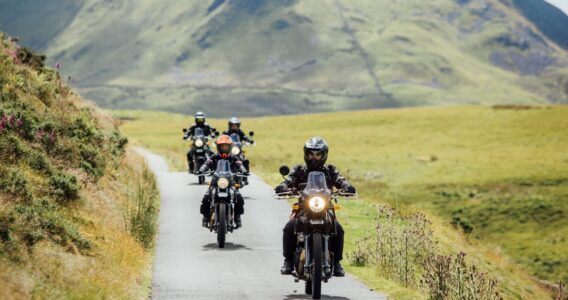
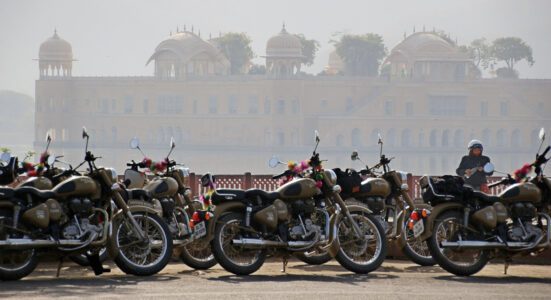
It’s the big day, our Royal Enfield is waiting for us! Hooked on this motorbike since we discovered it in India, we’re like children with a new toy. In the land of Gandhi, the Royal Enfield is a true legend. Full of charm and character with its retro British style and its unique, throaty roar, it transports you to another era with the first kick of the starter!
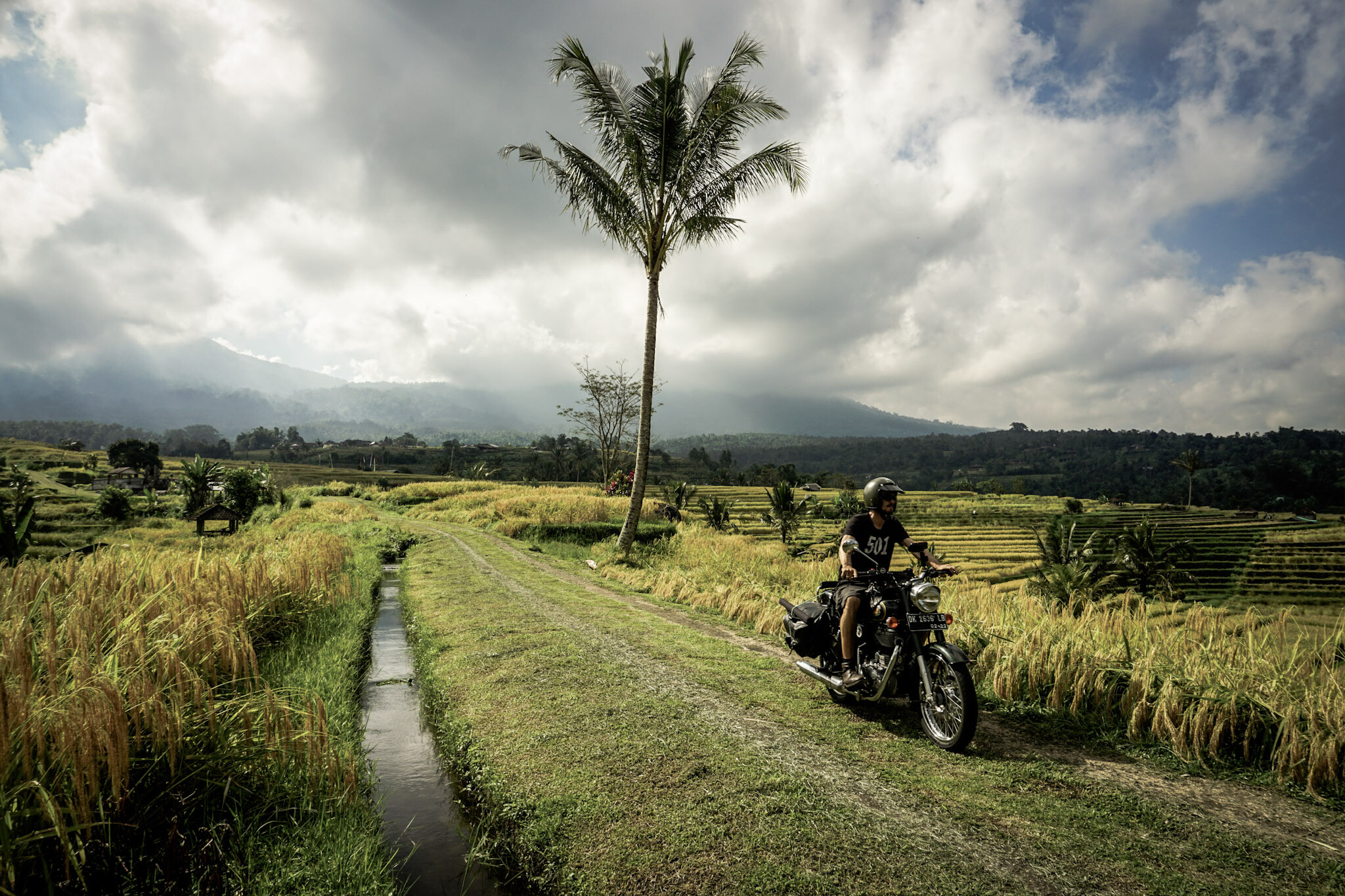
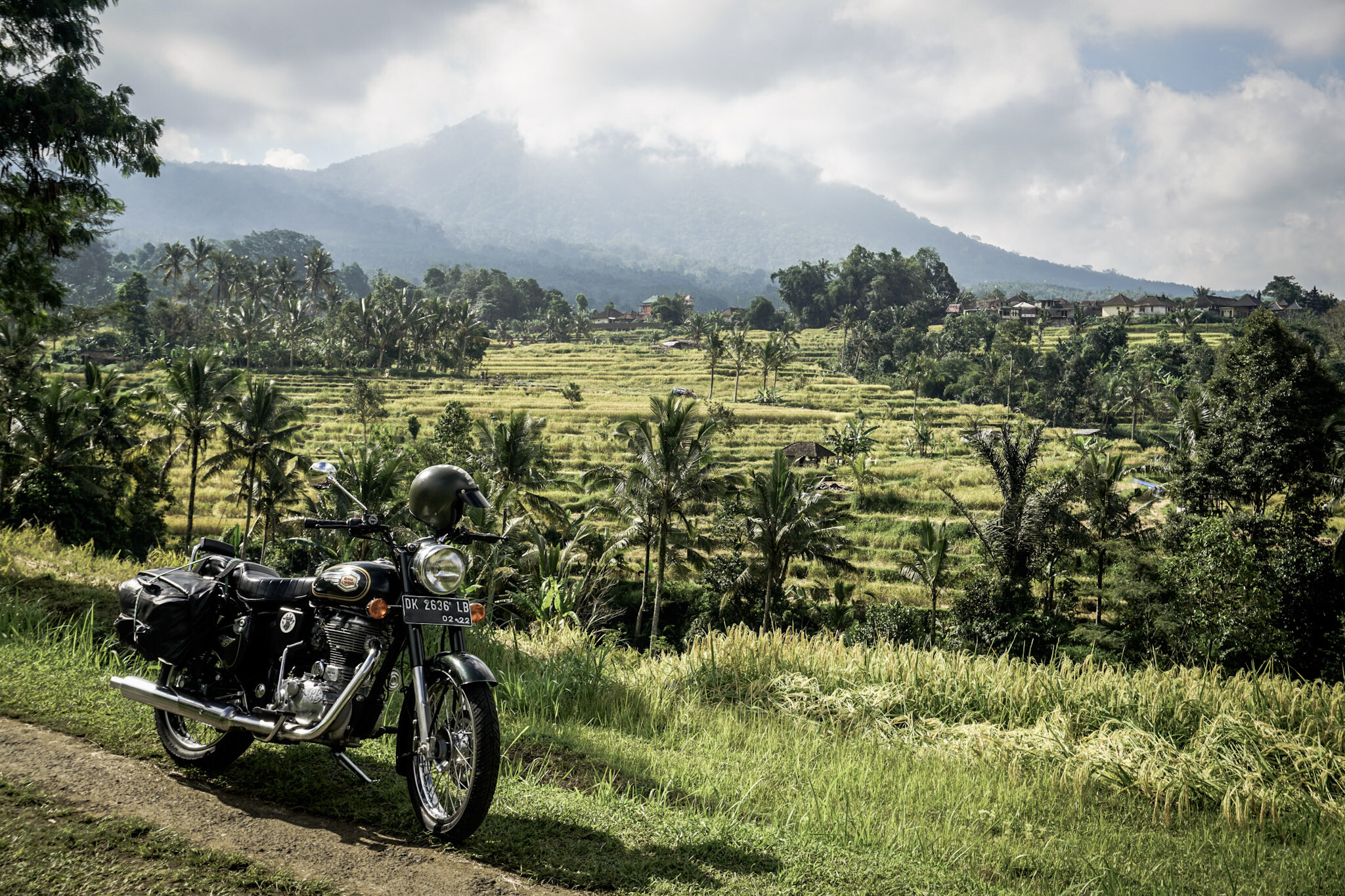
We make a final offering to Surya, the sun god, before starting our 10-day motorcycle tour. As soon as we leave Ubud, the Balinese countryside reappears, lush and authentic. The soil is exceptionally fertile here, and everything grows: coffee, cocoa, cloves, bamboo and, of course, rice.
Rice fields shape the landscape and occupy every inch of usable land. In Jatiluwih, we discover the Balinese Subak: a system of irrigation and water management unique in the world, based on democratic and egalitarian practices closely linked to Balinese spirituality. In the middle of the sparkling rice fields, ducks naturally clean and fertilise the soil. To protect this ancestral know-how, UNESCO added the Jatiluwih rice fields to its World Heritage List in 2012.
Java, the soul of Indonesia
We reach the north-western tip of Bali and the small town of Gilimanuk. Only 3 km of sea now separate us from Java. On the other side, people speak a different language and worship different gods. On board the ferry, we meet our first Javanese man, Arif, who comes from Banyuwangi, the main town in East Java. With his eyes fixed on the horizon, he has just finished smoking a kretek, an Indonesian cigarette flavoured with cloves.
It only takes a few turns of the wheel to realise that the traffic is much heavier here than in Bali! Java is the most populous island in the country, with over 140 million inhabitants. A stone’s throw from the chaotic hustle and bustle of Jember, rice fields and coffee plantations cover the landscape with an almost perfect aesthetic.
We pass through picturesque villages: children fly kites, chickens wander among mopeds, the muezzin’s call to prayer rings out, and Javanese people curious to see our crew shout ‘Hello Mister!’ at us. We stop at a warung, a small local restaurant, where we devour nasi goreng, a typical Indonesian dish consisting of cooked rice topped with a fried egg, sometimes accompanied by delicious chicken skewers with peanut sauce: satays.
A little old lady tries in vain to get us to taste a piece of durian. This strange fruit, covered in aggressive thorns, is an olfactory bomb that is difficult to bear. Laughter, photo sessions and a few exchanges mixing our English with Bahasa Indonesia. How sweet life seems and how happy the people are!

A Dantesque encounter
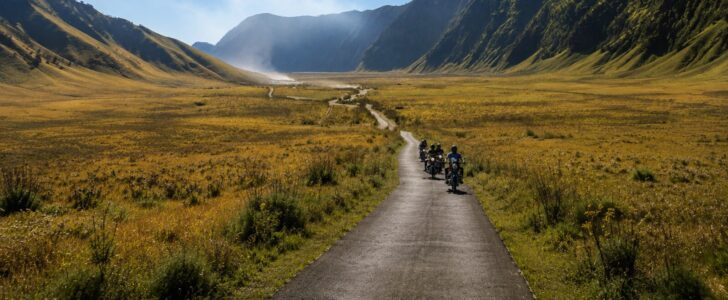
We set off again, the kilometres flying by. As we approach Mount Bromo, a new world appears. The journey turns into a fairy tale when we reach the village of Cemoro Lawang. The panorama that unfolds before our eyes leaves us speechless. In the distance, Semeru, rising to 3,676 m, spews smoke at regular intervals, as if to remind us of the intense activity of the site.
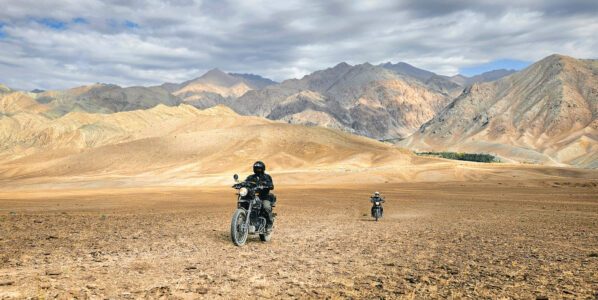
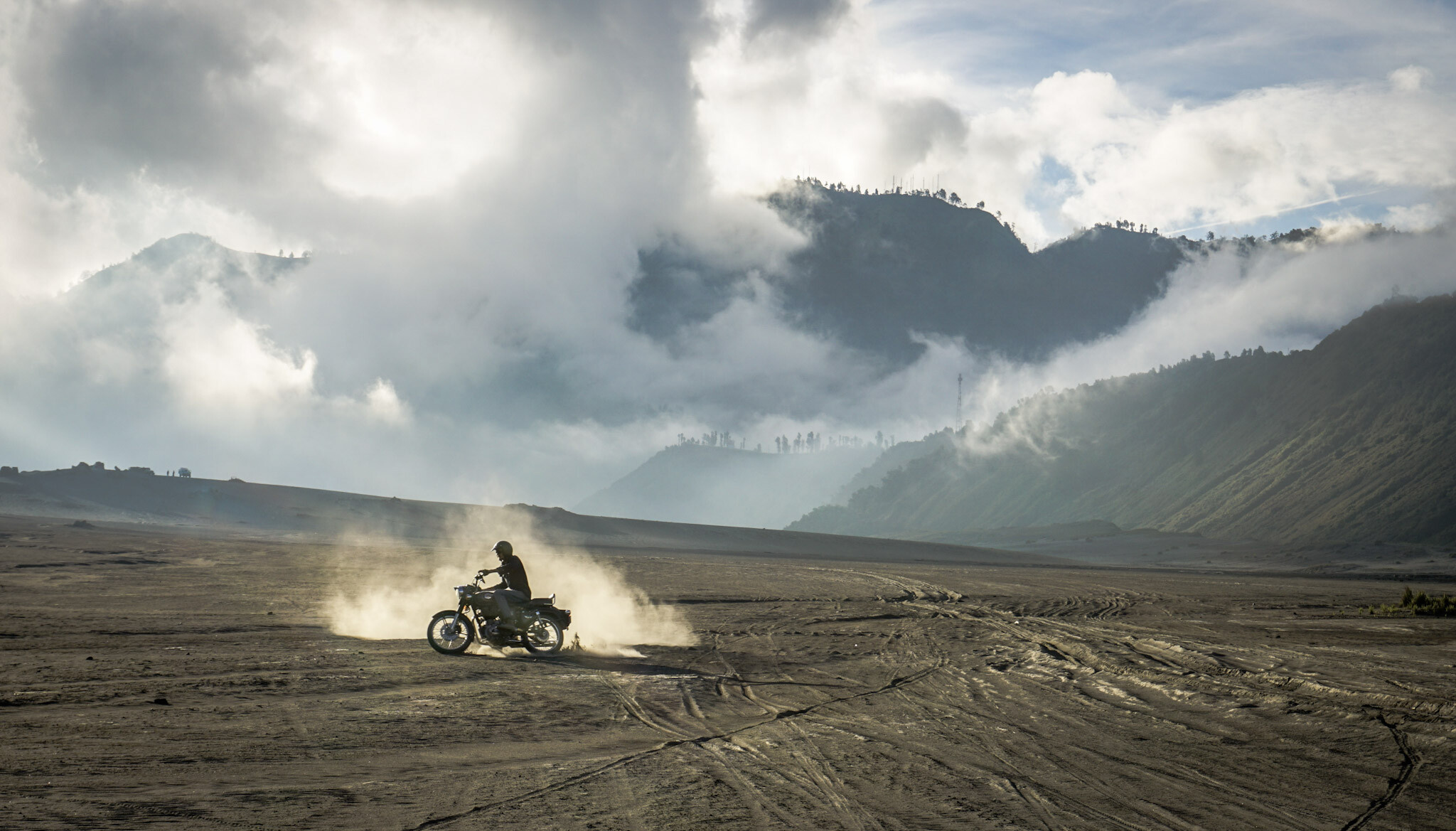
On the agenda: diving into the volcanic sand caldera with our bikes and having fun. Riding through these gigantic lunar landscapes transports us to another world, another time. We meet the Tenggers, a small Hindu community. Most are farmers or shepherds, some offer horse rides in the sea of sand. Every year, they gather for the fascinating Yadnya Kasadam ceremony to throw their offerings into the crater of the volcano, which is considered a deity.
In the evening, we take refuge in a cosy village restaurant over a cup of ginger tea. The Tenggers take the opportunity to sell scarves and hats to tourists surprised by the mountain climate. The fatigue of long days on the motorbike is beginning to set in, but we want to make the most of it and are eager to watch the sun rise over the smoking mountains.
After a short night, the second part of the show begins at 5:42 a.m. sharp, when the light of dawn transforms the scene into a symphony. The wisps of mist evaporate, the shadows change and reveal new colours on the reliefs, oscillating from black to blue, from purple to ochre.
t’s time to hit the road again, leaving Bromo and its caldera behind us, marking the final leg of our Asia motorcycle tour. Back in Banyuwangi, I am overcome by a strange feeling and I confide in François: ‘The return journey always seems quicker than the outward journey, don’t you think?’ On the ferry, we set our watches to Balinese time, which is now one hour ahead of Java.





 France
 United States
 United Kingdom
 Deutschland
 Euro (€)
 British Pound (£)


