From design to completion, Vintage Rides humanizes travel. Over 15,000 of you have experienced it around the world.
See all reviewsLooking for sunshine and escape? Set off on a motorcycle road trip in Tunisia, starting from Djerba la Douce. The Caravan Trail is a 7-day loop with 5 days of riding through southern Tunisia: the Berber villages of the Dahar mountains, the ksour around Tataouine, the oasis of Ksar Ghilane on the edge of the Sahara, Douz and the cave dwellings of Matmata, on a Royal Enfield Himalayan, with an English-speaking tour leader, a mechanic and a support vehicle for your luggage.
Women riders can join the same route on Chasing the Nomad Caravans, Girl’s Ride, with a female tour leader. Along the old caravan routes, our Tunisia motorcycle tours show you a different side of the country: its traditions, its crafts and its cuisine. Discover all our motorcycle tours in Africa.
Although Tunisia has more than 620 miles of coastline, over 30% of the country lies in the Sahara, alongside mountain ranges and fertile plains. Our Tunisia motorcycle tours ride the south of the country, on a loop from Djerba. You cross to the mainland on the ancient Roman causeway and climb into the Dahar mountains, to Tataouine and the ksour road, lined with fortified Berber granaries, and the hilltop village of Chenini.
The first dunes appear at Ksar Ghilane, an oasis on the edge of the Sahara. You then follow the fringe of the desert to Douz and its palm groves, ride along the eastern shore of the Chott el-Djerid, a vast salt lake, and return through the Dahar and the cave dwellings of Matmata, on your Royal Enfield, before the ferry back to Djerba.
This island is known for its sandy beaches, turquoise waters and sunshine. It is also the starting point of your Tunisia motorcycle tours, a chance to discover it differently, through its traditional markets and landmarks such as the El Ghriba synagogue. Nicknamed “Djerba la Douce,” it is the perfect place to relax before or after your ride.
In the south of the country, Tataouine is a must-see on any motorcycle road trip in Tunisia. Around it, the ksour, fortified granaries of stone and earth, and the hilltop villages of the Dahar offer a striking example of Berber architecture. The town is also famous for lending its name to the planet Tatooine in Star Wars. Long before the movies, its name already stood for a faraway place at the ends of the earth.
On your Tunisia motorcycle tours, Douz brings you face to face with the Sahara. Often called the “Gateway to the Sahara,” this oasis is known for its dunes and palm groves. Every year, Douz hosts the International Festival of the Sahara, celebrating nomadic culture with camel races and traditional dances.
In southern Tunisia, the Chott el-Djerid is a vast salt lake famous for its surreal scenery. In summer it dries up almost entirely, revealing glistening salt flats and mirages; after the winter rains, shallow water can cover parts of the basin. A unique landscape for travelers looking to escape the ordinary.
For a motorcycle road trip in Tunisia, aim for spring and fall: our departures run from March through May and from September through November. Weather is then generally dry and sunny, and these months fall outside the peak tourist season, meaning less traffic and a more peaceful experience on the roads.
Tunisia’s climate changes from north to south. In spring, while the south is pleasantly warm, the Mediterranean coast in the north can see rain. Avoid summer, when temperatures inland and in the south can climb well above 104°F (40°C).
During our travel periods, expect daytime highs of around 68 to 86°F. Desert nights can get chilly, so bring warm layers, but during the day the Sahara reveals all its splendor under a bright sky.
Tunisia is the smallest country in the Maghreb, bordered by the Mediterranean Sea to the north and east, Algeria to the west and Libya to the southeast. The north carries the last ranges of the Atlas, greener and more wooded. The center is a transition zone of plateaus and semi-arid plains.
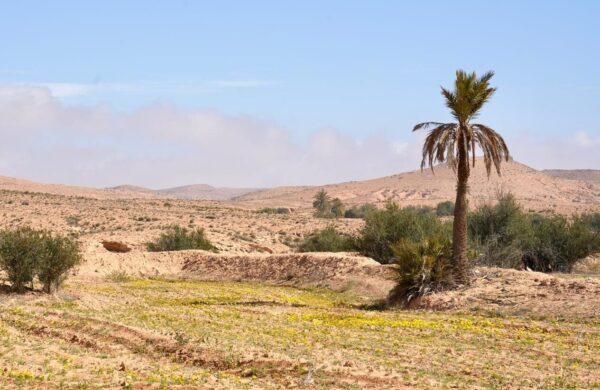
The south, where our Tunisia motorcycle tours ride, is the most spectacular: the island of Djerba in the Gulf of Gabès, the arid Dahar mountains, the great salt lake of the Chott el-Djerid, then the dunes, ergs and regs of the Sahara, dotted with oases such as Ksar Ghilane and Douz.
A motorcycle raid in Tunisia is also a journey through the country’s rich history. Tunisian culture is a blend of Berber, Arab, Roman, Ottoman, and French influences, reflecting its complex and layered past. The medinas of Tunis, Kairouan, and Sousse, all UNESCO World Heritage Sites, showcase traditional architecture with lively souks, ancient mosques, and winding alleyways.
Riding through Tunisia also means sampling its culinary treasures, a fusion of Mediterranean and North African flavors with seafood, fresh vegetables, and local spices. Arabic is the official language, but French is widely spoken.
In 1881, Tunisia became a French protectorate, and it remained under colonial rule until it gained independence on March 20, 1956. Today, strong cultural, diplomatic, and economic ties with France remain, reinforced by the widespread use of the French language.
Islam is the dominant religion and plays a significant role in daily life and social customs. Tunisian culture beautifully blends ancient traditions with modern influences, a richness that locals are eager to share with travelers passing through on their Tunisia motorcycle tours.
If you’re craving more epic riding experiences, don’t miss our Africa motorcycle tours.
We ride southern Tunisia on a single route, offered in two formats. The Caravan Trail is our tour open to all, riders and passengers: a 7-day loop from Djerba through the Dahar mountains, the ksour road, the Ksar Ghilane oasis, Douz and Matmata. Chasing the Nomad Caravans, Girl’s Ride follows the same route with women riders only, a female tour leader and its own dates. For more North African landscapes, see our Morocco motorcycle tours.
$2,490 per rider and $2,090 per passenger, for 7 days including 5 days of riding: the price is the same for The Caravan Trail and the Girls Ride. It covers the motorcycle, gas, the team, lodging and almost all meals; each tour page gives the details. On top, budget for your flights, drinks and, on your first tour with us, a $41 registration fee.
In spring and fall, away from the summer heat of the south: our departures run from March through May and from September through November, and the Girls Ride leaves in May and October. In these months, expect daytime highs of around 68 to 86°F, with cool mornings and evenings on the edge of the desert. Open dates are listed on each tour page.
Both formats are rated Intermediate. You should ride regularly and be comfortable off pavement: stages of 100 to 155 miles mix mountain roads and stretches of dirt, with sand around Ksar Ghilane and Douz. Never ridden off-road? Prepare with an off-road training day in France; women riders can also choose the Girls Ride off-road training.
According to our help center, US passport holders do not need a visa for a tourist stay of under 90 days, and the passport should be valid for at least six months after arrival. No International Driving Permit is needed, but your motorcycle license must travel with you. Other nationalities should check their situation before booking. The full list is in our help center: Preparing your trip to Tunisia.
By air to Djerba, usually with at least one connection from the US, through Tunis or a European hub. Both formats start and end at Djerba airport: you book your own flights, and our team meets you on the first day and takes you back on the last. Tunisia does not change its clocks: it is 6 hours ahead of New York in winter and 5 hours in summer.
Our tours stay in southern Tunisia, between Djerba, the Dahar and the edge of the Sahara, on a route our team knows well. The main risk is the road itself: unpredictable traffic, sand on the pavement and stages far from medical help. Every group rides with a tour leader, a mechanic and a support vehicle, and our team answers 24/7 in an emergency. Before you go, check the U.S. Department of State travel advisory and country information for Tunisia, and enroll in STEP, the Smart Traveler Enrollment Program.
Not with us: both our Tunisia formats are guided tours. Riding on your own means finding a motorcycle locally, planning the route and handling mechanics, paperwork and surprises by yourself, in a country where road signs are mostly in Arabic and French. With us, the motorcycle is waiting in Djerba, the nights are booked and an English-speaking tour leader rides ahead. We ride with 10 motorcycles at most, 12 participants with passengers.