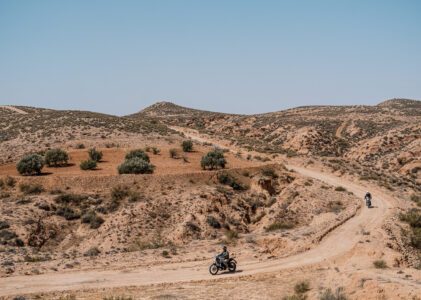
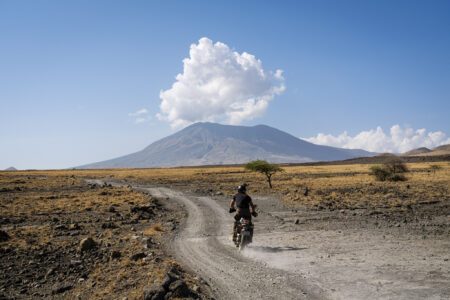
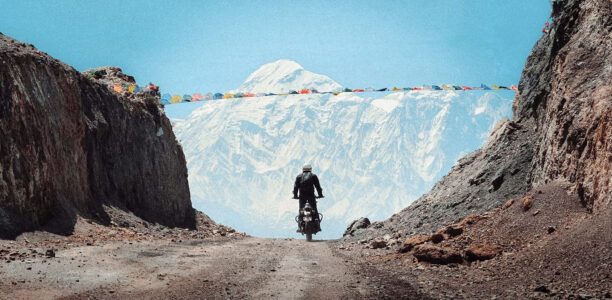
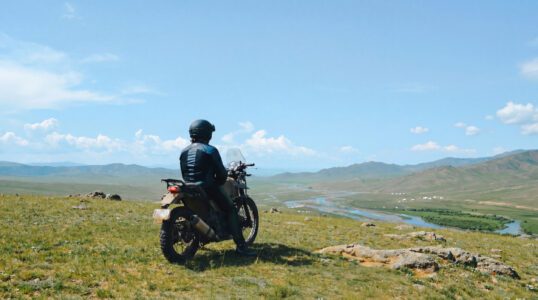
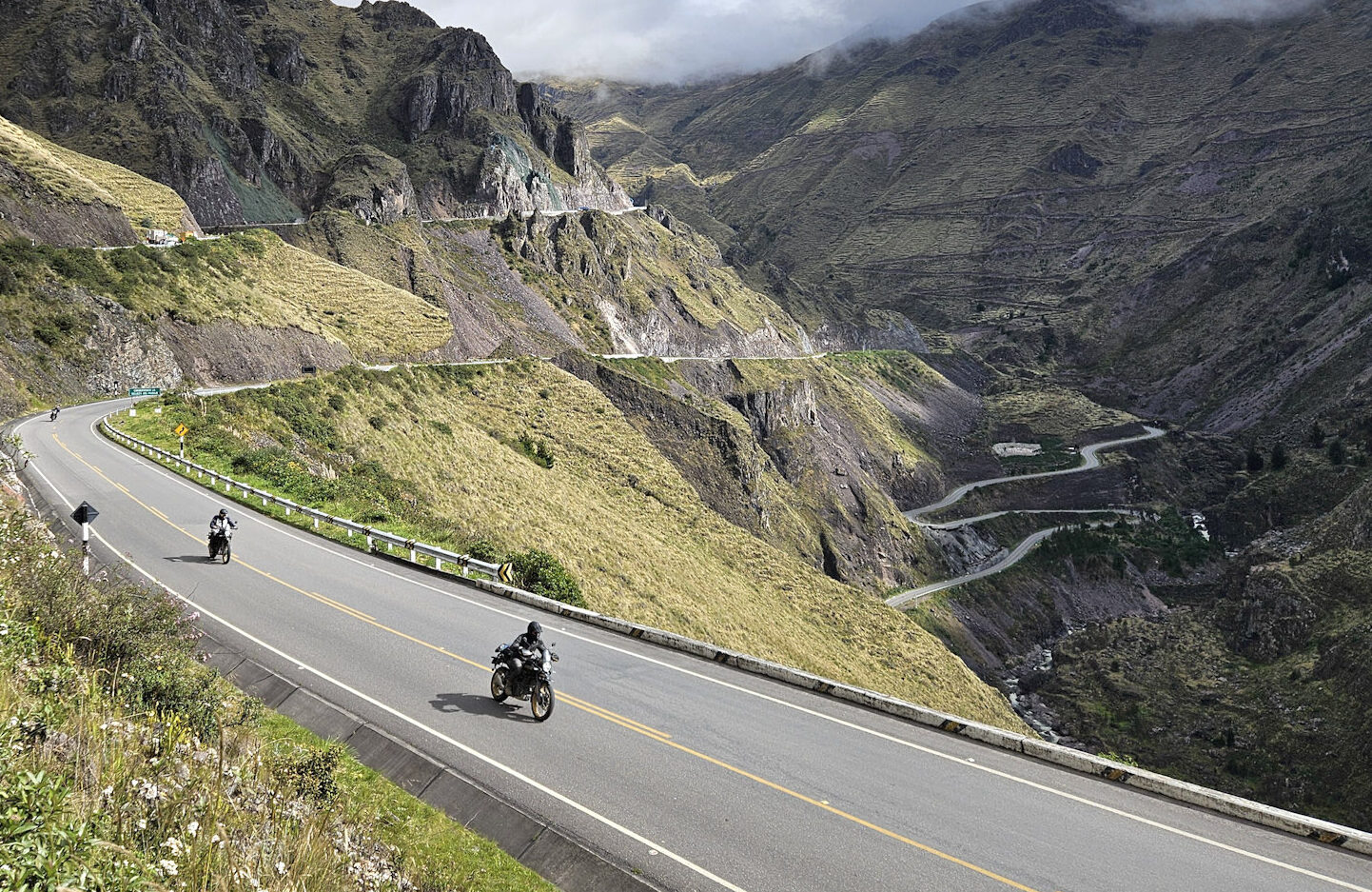
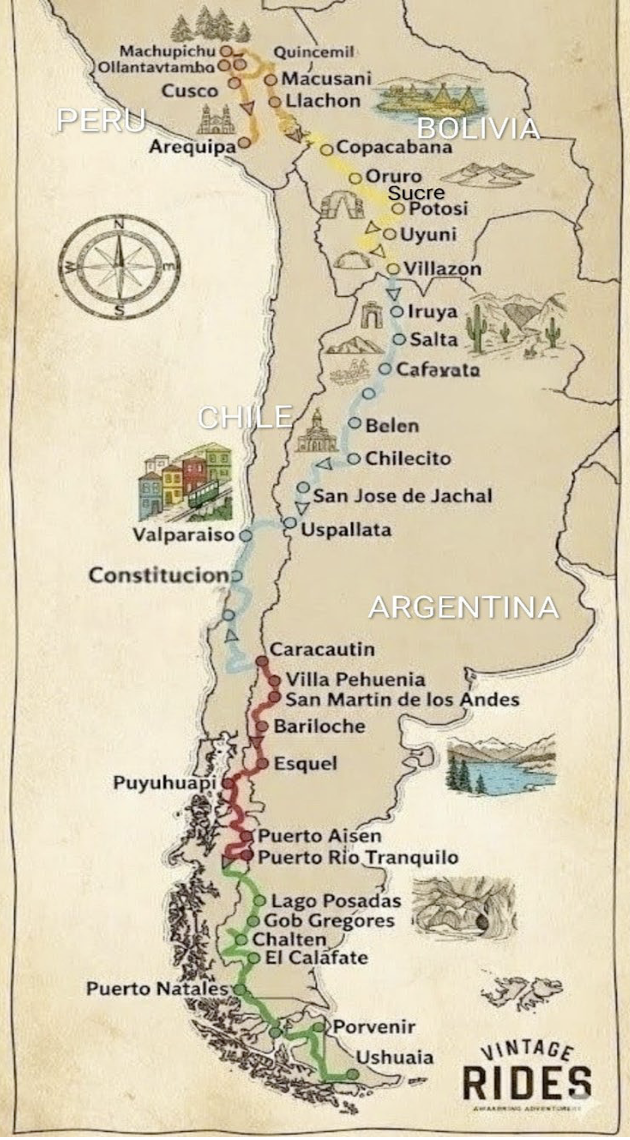
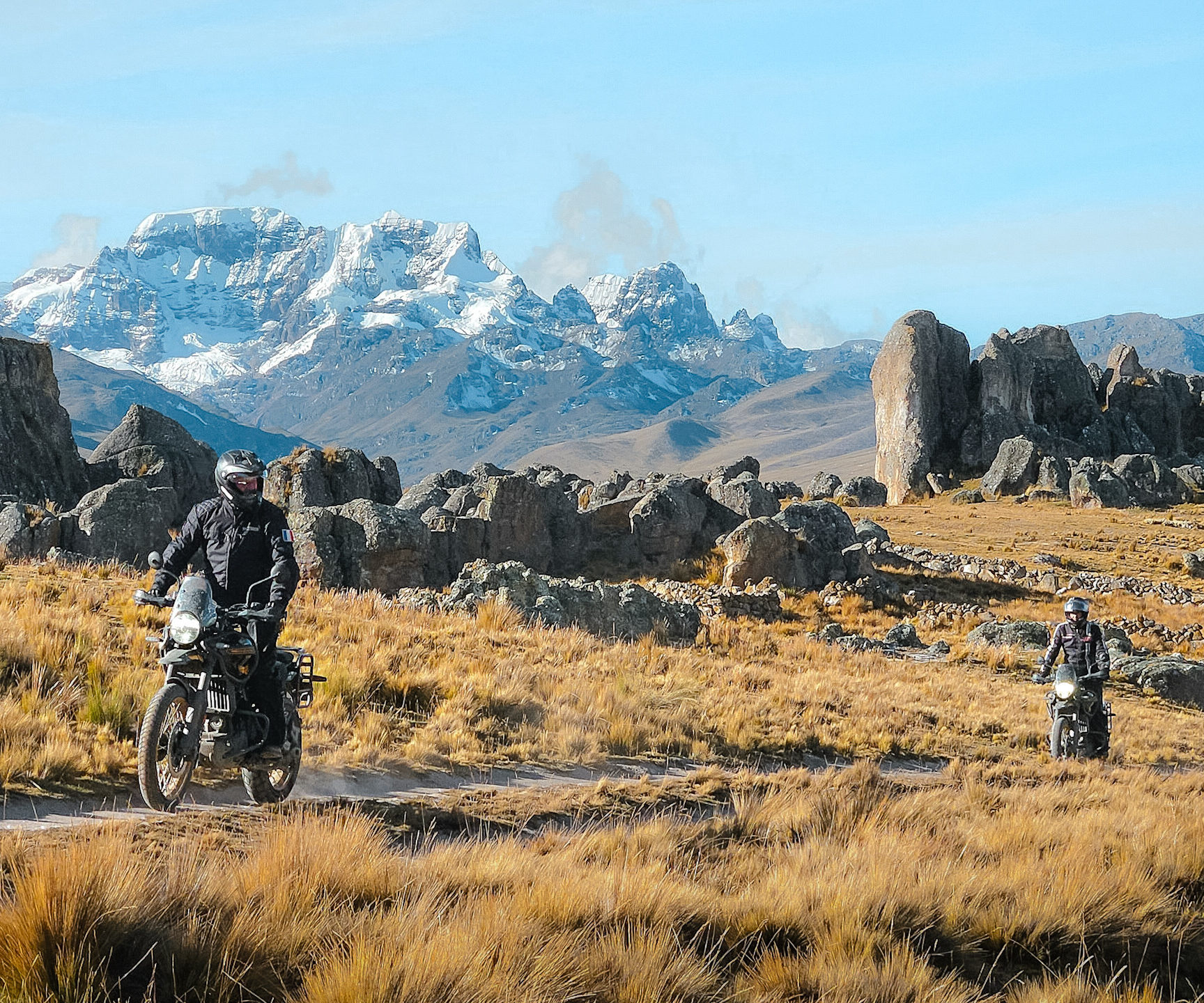
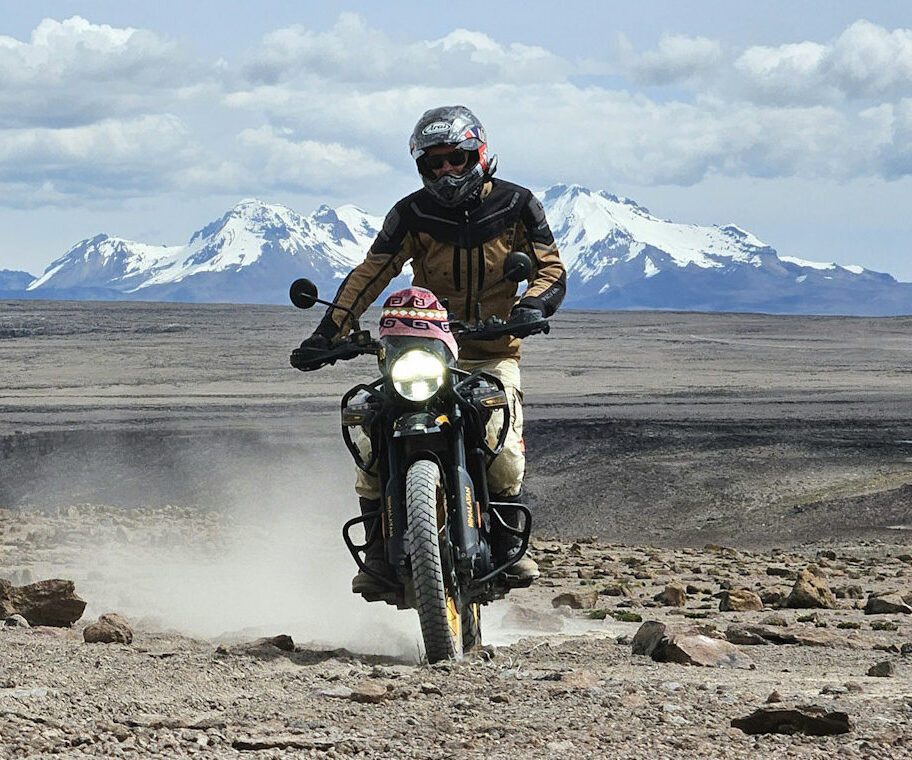
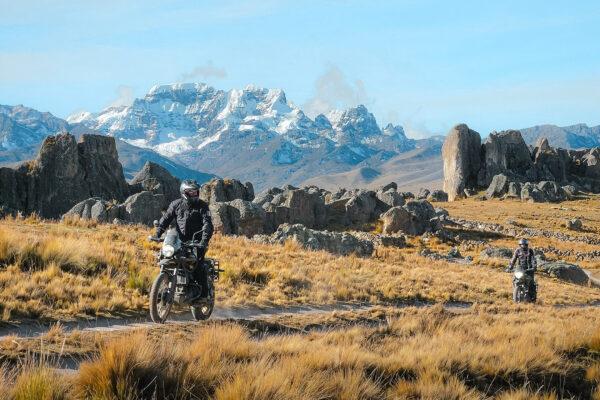
Welcome to Peru, in Arequipa, the "White City" dominated by the Misti and Chachani volcanoes. After discovering its UNESCO-listed center — the Plaza de Armas, the majestic cathedral, and the Santa Catalina monastery — the motorcycle adventure begins from Hotel Villa Elisa. Climbing toward the Salinas Reserve, asphalt soon gives way to dirt roads: a lunar-like landscape of salt lagoons and active volcanoes leads us across the Altiplano to Espinar, amidst alpaca herders.
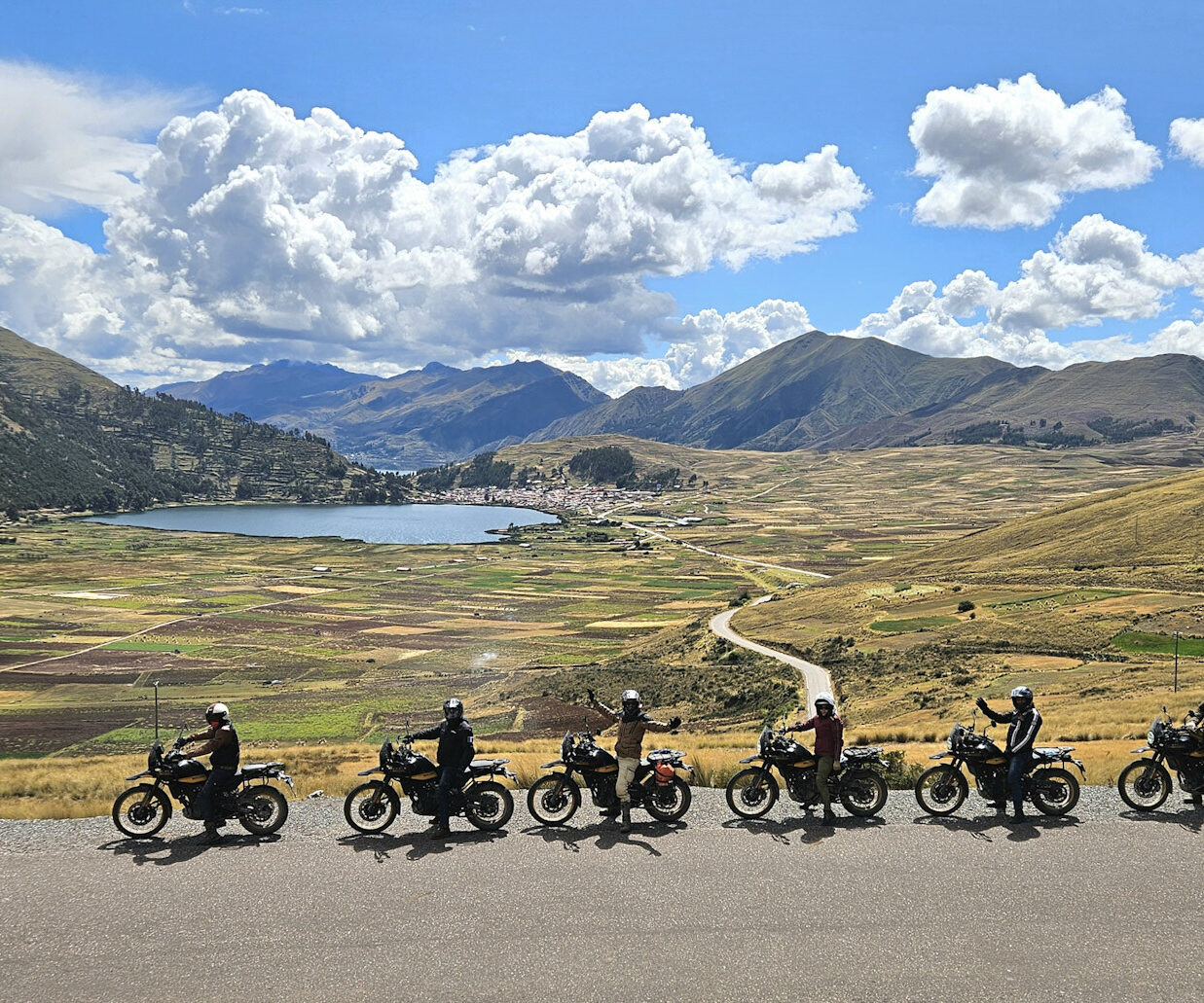
The route then dives into history, winding through canyons and high-altitude lakes to reach Cusco, the navel of the world. After exploring its streets, we head to the Sacred Valley and the salt mines of Maras. We follow the Urubamba River to Ollantaytambo, where we stay facing the fortress and glaciers. From there, the Machu Picchu experience is a journey through time: its verdant terraces and stone temples suspended in the clouds showcase pre-Columbian genius.
The scenery changes dramatically after a 4,700 m pass: a breathtaking descent takes us into the humid Amazon at Quincemil. After a sensory immersion on a cacao farm, we climb from 600 to 4,300 m through spectacular hairpin turns to Macusani, the "alpaca capital." Finally, crossing the raw Altiplano and its isolated villages, the deep blue of Lake Titicaca comes into view. We stop at Llachon, at the tip of a peninsula. A crossing to Taquile Island offers a final meditative and ancestral pause before continuing the adventure toward Bolivia.
Day 1: Arequipa → Salinas-Espinar – 241 km (off-road: 170 km)
Day 2: Espinar → Cusco – 240 km (off-road: 70 km)
Day 3: Cusco → Ollantaytambo – 97 km (off-road: 36 km)
Day 4: Machupichu → Machupichu – 0 km
Day 5: Ollantaytambo → Quincemil – 316 km (off-road: 36 km)
Day 6: Quincemil → Macusani – 228 km (off-road: 3 km)
Day 7: Macusani → Llachon – 254 km (off-road: 86 km)
Day 8: Llachon → Llachon – 0 km.
We leave Llachon, riding along the indigo shores of Lake Titicaca (3,800 m) to reach the Bolivian border and its snow-capped mountains. A stop in Copacabana immerses us in local traditions before crossing the vast Altiplano to Oruro, where the smiles of the locals warm the atmosphere. The scenery then softens in the green valleys leading to Sucre, the "White City." This UNESCO-listed colonial gem offers a touch of elegance before the pilgrimage to Potosí. At over 4,000 meters, under the shadow of the mythical Cerro Rico, you swap your motorcycle helmet for a miner's helmet to explore the depths of the famous silver and gold mines.
The route to Uyuni crosses arid and wild plains. After passing the train cemetery, the landscape becomes surreal in front of the Salar de Uyuni, an endless salt ocean where we stay in a salt hotel. Exploring this giant mirror takes us to Incahuasi Island, crowned with giant cacti and llamas. Heading south through Tupiza and Villazón, the land turns ochre and blood-red as we approach the Argentine border.
The Quebrada de Humahuaca (UNESCO) then opens its doors: at the end of a winding path, the village of Iruya appears like a postcard in the heart of multicolored valleys. The descent is a symphony of colors, passing through the authenticity of Purmamarca and the traditions of northern Argentina. The final turns guide us to Salta, "la Linda." In this beautiful colonial city, we celebrate the stage with a traditional asado and folk music, ready for the next chapter of our adventure in gaucho lands.
Day 9: Llachon-Peru → Copacabana-Bolivia – 242 km
Day 10: Copacabana → Oruro – 358 km
Day 11: Oruro → Sucre – 328 km
Day 12: Sucre → Potosi – 154 km
Day 13: Potosi → Uyuni – 246 km
Day 14: Uyuni → Uyuni – 0 km
Day 15: Uyuni → Villazon – 312 km (off-road: 27 km)
Day 16: Villazon-Bolivia → Iruya-Argentina – 182 km (off-road: 47 km)
Day 17: Iruya → Salta – 315 km (off-road: 60 km)
Day 18: Salta → Salta – 0 km.
The heat rises as we depart Salta, the compass pointing south through the Quebrada de las Conchas, a glowing red canyon with natural amphitheaters, to reach the lush vineyards of Cafayate and its renowned bodegas. The route becomes a challenge toward Belén: gravel tracks weave between the abandoned mines of Minas Capillitas, followed by remote trails where riding becomes instinctive across dried riverbeds, under the watchful eyes of the few shepherds.
We reconnect with the famous Ruta 40 in Chilecito to savor the curves of the Cuesta de Miranda in the heart of a vivid red valley. The journey takes on an otherworldly feel in the Valley of the Moon (Ischigualasto Park), a fossil desert dotted with rock mushrooms and dinosaur footprints, before reaching San José de Jáchal, like an oasis at the foot of the Andes. Heading west, the corrugated metal tracks of Uspallata lead us to the legendary Paso Caracoles: its 29 dizzying hairpins mark the spectacular entry into Chile and the descent toward the Pacific.
Distances are given as an indication.
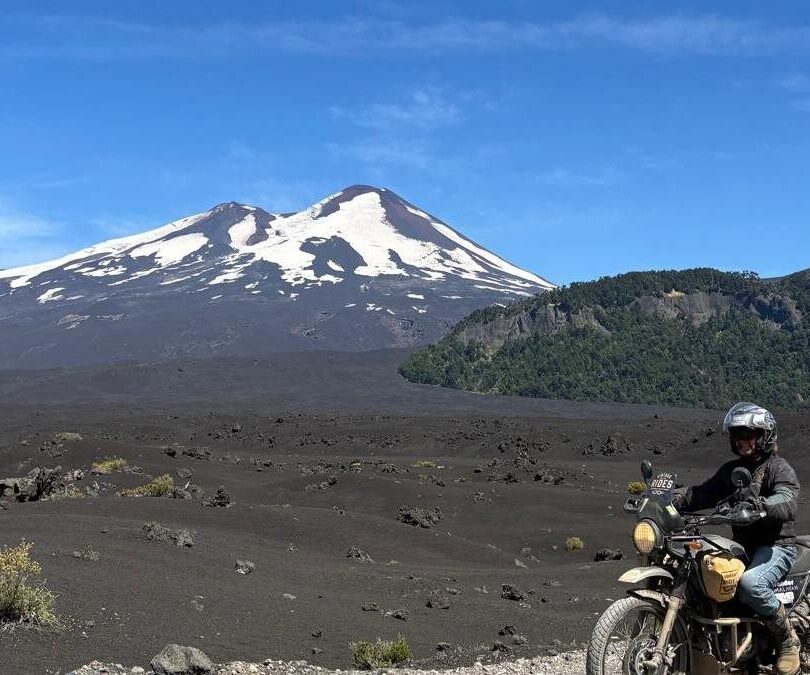
Valparaíso then welcomes us, a chaotic and colorful port where we explore on foot this open-air museum of poetic street art. Riding along the coast to Constitución, the salty air accompanies a landscape of cliffs, wild beaches, and pine forests. Finally, the adventure takes us inland, trading aridity for the dense, humid greenery of the volcanoes. The village of Curacautín greets us, a peaceful haven nestled opposite the majestic Llaima volcano and its millenary araucarias.
Day 19: Salta → Cafayate – 264 km (off-road: 98 km)
Day 20: Cafayate → Belen via Andalgala – 305 km (off-road: 100 km)
Day 21: Belen → Chilecito via Tinogasta – 226 km (off-road: 56 km)
Day 22: Chilecito → San Jose de Jachal – 335 km (off-road: 59 km)
Day 23: San Jose de Jachal → Uspallata – 397 km (off-road: 35 km)
Day 24: Uspallata-Argentina → Valparaiso-Chile – 297 km
Day 25: Valparaiso → Valparaiso – 0 km
Day 26: Valparaiso → Constitucion – 391 km (off-road: 7 km)
Day 27: Constitucion → Caracautin – 497 km.
The adventure resumes in Conguillío National Park, where our motorcycles wind along a black ash track among millenary araucarias, under the watchful eye of Llaima volcano. After crossing the Argentine border to Villa Pehuenia, we reach the Seven Lakes region. Between asphalt and ochre dust, we pass crystal-clear lakes such as Lake Moquehue and its raw forests to arrive at San Martín de los Andes, taking time for an asado with the locals.
Continuing on the trail, the panoramas follow one another: Lanín volcano dominates the horizon, while emerald lakes like Meliquina glide by before descending toward Bariloche. Patagonia becomes more alpine, almost European, and a welcome stop allows us to ride along Lake Nahuel Huapi, stroll through the town, and enjoy chocolates and craft beers. Heading south again toward Esquel, we cross national parks with millenary cypresses and turquoise lakes, before re-entering Chile via Futaleufú, where deep canyons and abundant rivers contrast sharply with the Argentine pampas.
We then begin the legendary Carretera Austral at Puyuhuapi, a thermal village nestled in a fjord surrounded by hanging glaciers and waterfalls. Ruta 7 leads us through Queulat National Park and fishing villages to Puerto Aysén, a small port with colorful houses overlooking misty bays. Finally, the route becomes spectacular toward Puerto Río Tranquilo, on the edge of Lake General Carrera. There, a boat trip to the Marble Caves reveals a labyrinth of natural grottoes with bluish reflections, the ultimate recharge before the final leg of the journey.
Day 28: Caracautin-Chile → Villa Pehuenia-Argentina – 133 km (off-road: 55 km)
Day 29: Villa Pehuenia → San Martin de los Andes – 255 km (off-road: 80 km)
Day 30: San Martin de los Andes → Bariloche – 380 km (off-road: 100 km)
Day 31: Bariloche → Bariloche – 0 km
Day 32: Bariloche → Esquel – 348 km
Day 33: Esquel-Argentina → Puyuhuapi-Chile – 245 km (off-road: 90 km)
Day 34: Puyuhuapi → Puerto Aysen – 265 km (off-road: 70 km)
Day 35: Puerto Aysen → Puerto Rio Tranquilo – 278 km (off-road: 100 km)
Day 36: Puerto Rio Tranquilo → Puerto Rio Tranquilo – 0 km.
We leave Puerto Río Tranquilo for the Paso Roballo border, a “no man’s land” of demanding tracks swept by the winds. Back in Argentina, among herds of guanacos and vast blue lakes, we reach Lago Posadas. The route to Gobernador Gregores brings us back onto the legendary Ruta 40, where we face the challenge of the “Malditos 73”: 73 kilometers of unstable gravel and crosswinds testing our machines.
The reward appears on the horizon: the summit of Fitz Roy tearing through the clouds at the grand entrance to El Chaltén, where we enjoy a stop in the heart of Los Glaciares National Park. The adventure continues toward El Calafate, following the traces of Butch Cassidy along Lago Argentino, until the visual shock of the Perito Moreno Glacier, a roaring ice wall 60 meters high.
Riding along Torres del Paine National Park, we reach Puerto Natales, the last Chilean stop before entering Tierra del Fuego. After crossing the Strait of Magellan by ferry to Porvenir, we traverse windswept forests and dark peatlands. Finally, Ushuaia emerges between the mountains and the Beagle Channel. At the end of Ruta 3, in Tierra del Fuego National Park, we cut our engines facing Antarctica.
This 45-day odyssey ends here, at the southernmost point of the globe, sealing an extraordinary human and mechanical adventure.
Day 37: Puerto Rio Tranquilo-Chile → Lago Posadas-Argentina – 235 km (off-road: 235 km)
Day 38: Lago Posadas → Gob Gregores – 180 km (off-road: 72 km)
Day 39: Gob Gregores → Chalten – 295 km (off-road: 73 km)
Day 40: Chalten → Chalten – 0 km
Day 41: Chalten → El Calafate – 360 km (off-road: 40 km)
Day 42: El Calafate-Argentina → Torres del Paine-Chile – 288 km (off-road: 40 km)
Day 43: Torres del Paine-Chile → Puerto Natales – 85 km
Day 44: Puerto Natales → Porvenir – 285 km
Day 45: Porvenir-Chile → Estancia Harberton-Argentina – 436 km (off-road: 126 km)
Day 46: Estancia Harberton → Ushuaia – 75 km.
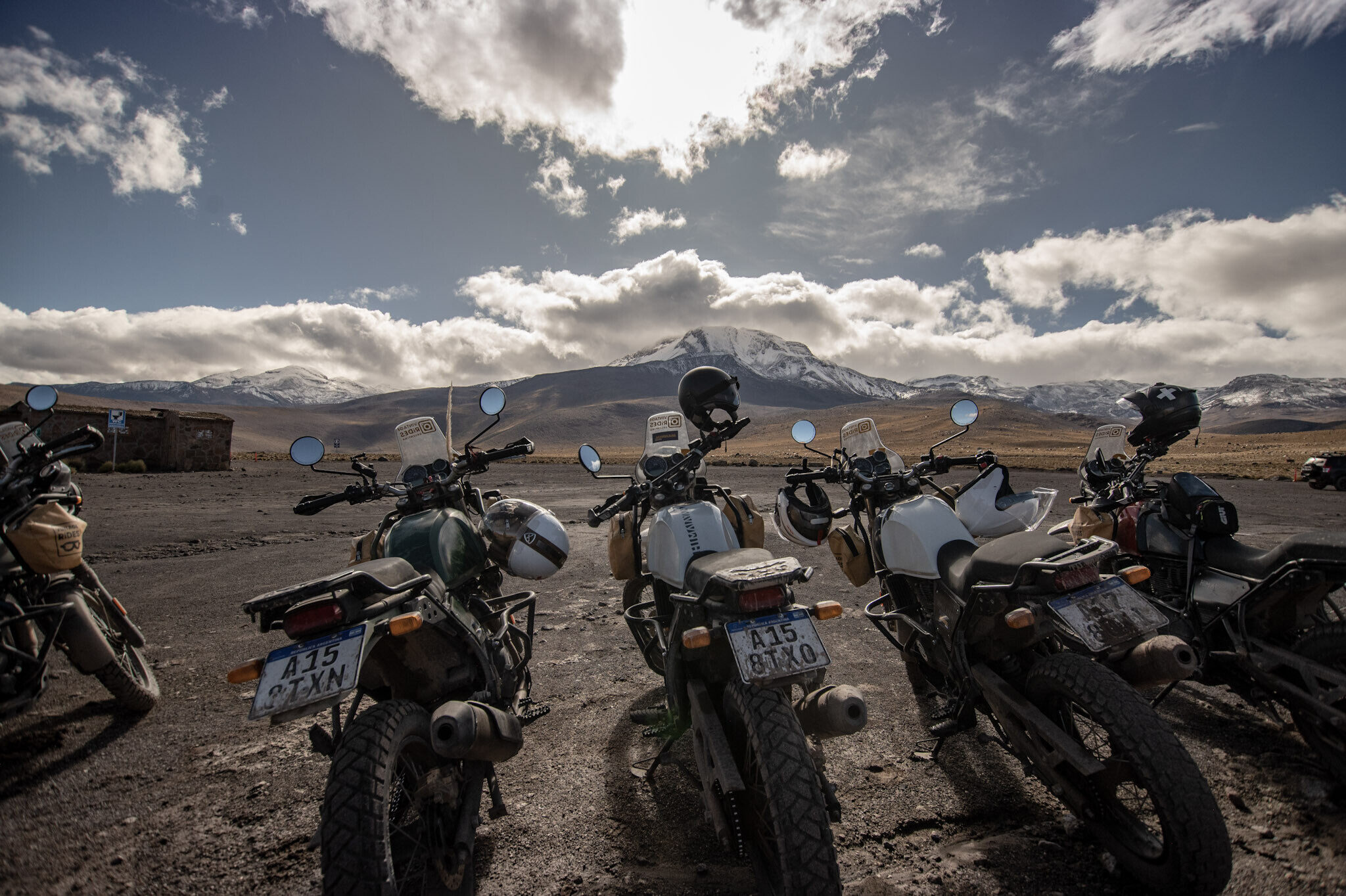
A Royal Enfield Himalayan 450 motorcycle.
A French- and English-speaking motorcycle guide (on riding days).
A support vehicle for luggage and assistance with a driver and mechanic. The vehicle can accommodate 1 motorcycle passenger when strictly necessary.
Meals (estimated 40 euros/day).
Fuel (estimated 15 euros/day).
Entrance fees to parks, museums, and other historical sites (approximately 290 euros for Machu Picchu).